Publishing & creative production

Your story,
in every format.

Turn a manuscript or an idea into a book, an audiobook or a multilingual release. One studio coordinates the people, the production and the final files.

An open illustrated book with a celestial chart, resting on navy cloth beside a brass pencil.Global iNet World Pro

Where would you like to start?

Bring an idea, a manuscript or materials already in production. We select the stages your project needs and define the deliverables together.

Full project delivery

Produce my project

Bring your idea or manuscript. We coordinate the editorial, design, production and release stages your brief calls for.

  • A defined brief and production schedule
  • Coordinated specialists and review stages
  • Agreed editions, formats and final files
Discuss a complete project
Selected services

Choose a service

Bring in a specialist to illustrate a manuscript, record an audiobook, translate an edition or prepare release assets.

  • Work from your existing materials
  • A focused scope with clear handoffs
  • Deliverables ready for your next stage
Tell us what you need
Phased development

Develop a sample

Begin with research, a concept or a sample before deciding on the next stage of production.

  • A clearly defined first milestone
  • A sample page, storyboard or audio demo
  • A decision point before further investment
Plan a first step

Scope, timing, budget, usage permissions and included revisions are agreed before production begins.

Explore the studio.

Choose what you want to understand first. Each path takes you directly to the relevant section.

Four phases.
One connected process.

Follow the path from a clear brief to a finished release. Select a phase to explore the people, materials and decisions behind it.

A clear brief before production

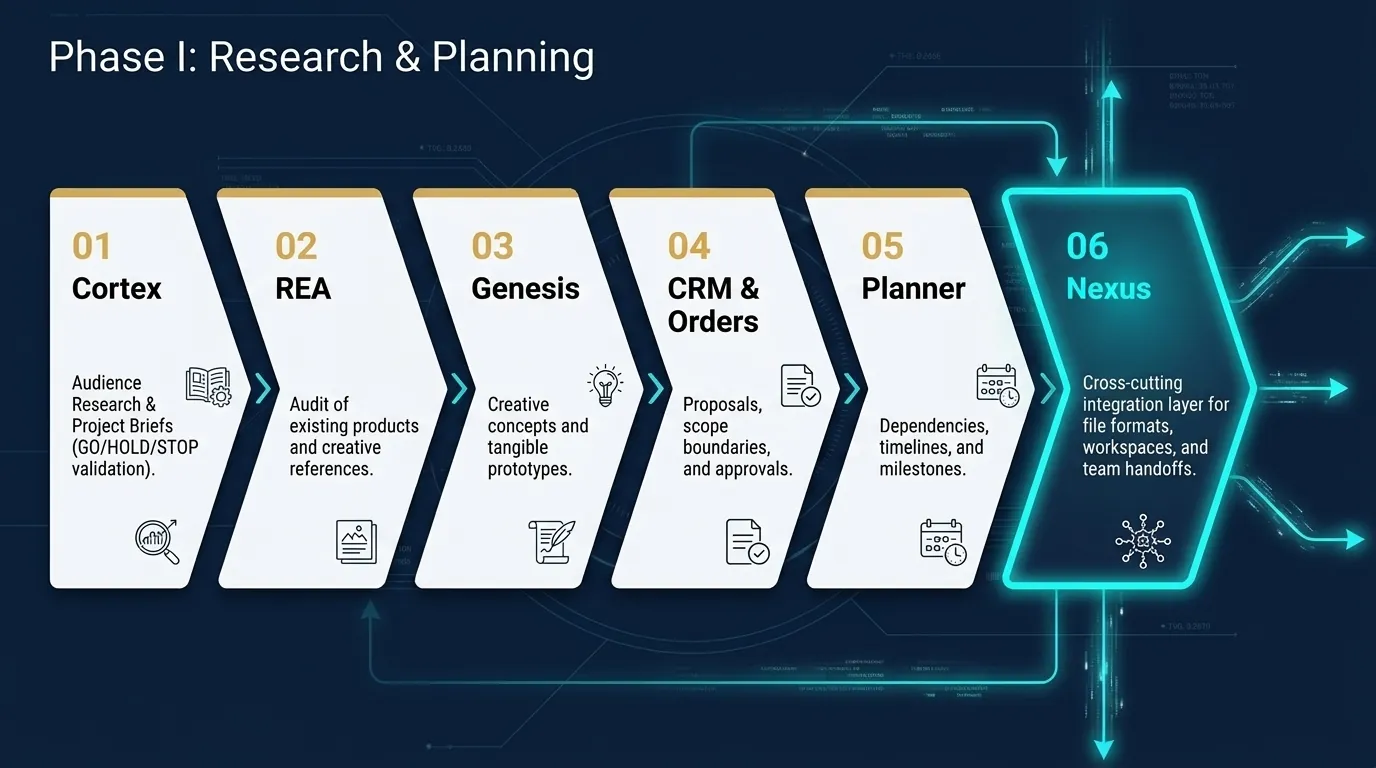
Define the audience, review references, explore the concept and agree the scope. Confirm milestones and the handoffs between specialists.

Explore these modules
Research and Planning. Define the audience, review references, explore the concept and agree the scope. Confirm milestones and the handoffs between specialists.Enlarge diagram

Creator Studio

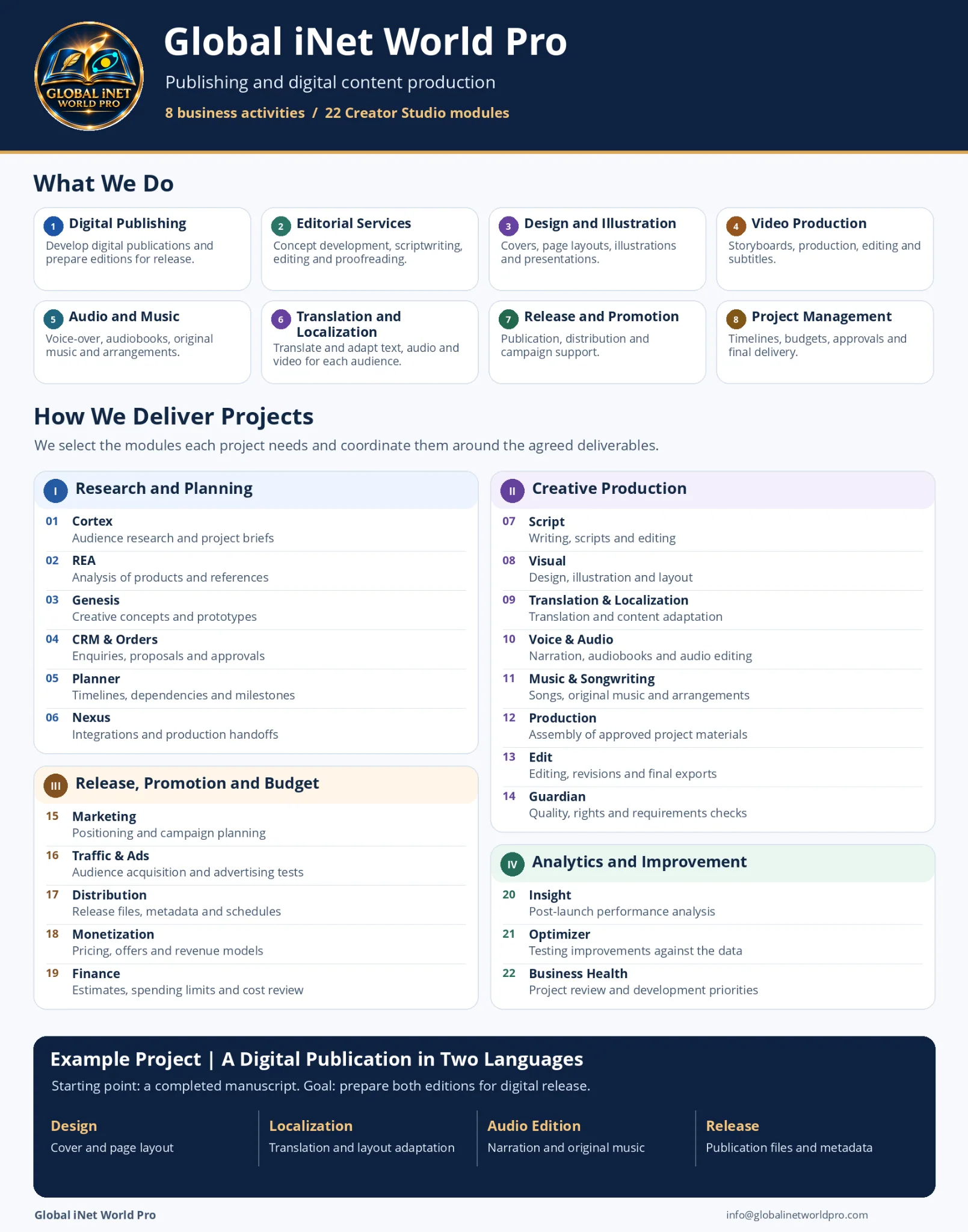
Explore the 22 modules behind our production workflow. Open any module for its process diagram and full description.

View the illustrated studio overview
Choose a module to explore its process.

Research and Planning6 modules

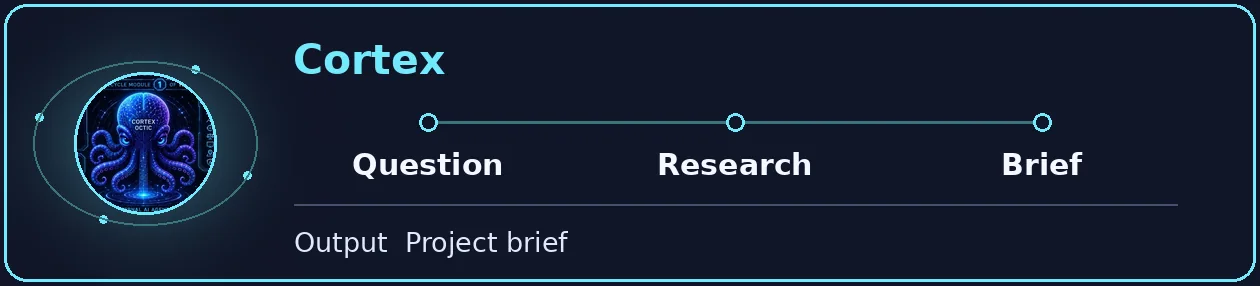
Cortex. Question, Research, Brief. Output: Project brief.01Audience research and project briefStudio module · Cortex
Cortex. Question, Research, Brief. Output: Project brief.

Cortex turns an initial idea into a brief the project team can work from. It identifies who the work is for, what those people need, and where they are likely to encounter it. Interviews, audience feedback, and existing materials help clarify the problem the client wants to solve. The brief records the project’s objective, practical constraints, and criteria for success. For an educational publication, that could mean defining what readers should be able to do after completing each chapter.

REA. References, Review, Findings. Output: Annotated reference set.02Review of existing work and creative referencesStudio module · REA
REA. References, Review, Findings. Output: Annotated reference set.

REA examines existing publications, media products, and creative references relevant to the assignment. It compares how those examples handle structure, navigation, pacing, or presentation. It records which techniques could suit the project and what would need to change for a different audience or format. An audit of the client’s existing assets can uncover useful material, such as an illustrated guide worth adapting for mobile reading. The result is a reference set with a practical reason for including each example.

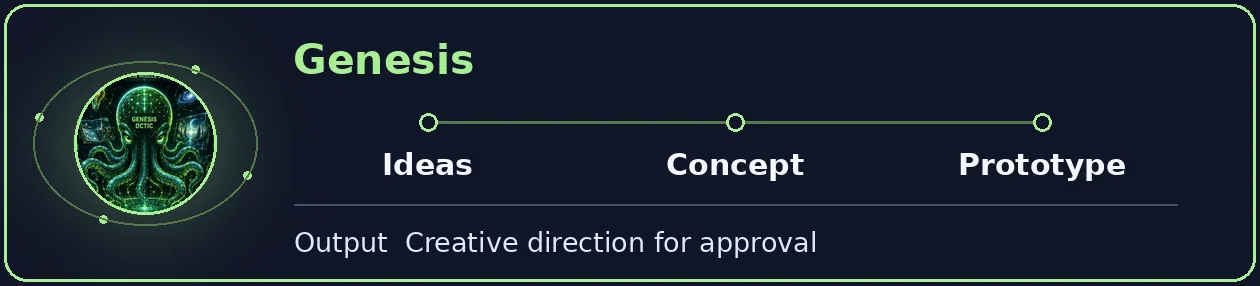
Genesis. Ideas, Concept, Prototype. Output: Creative direction for approval.03Creative directions and prototypesStudio module · Genesis
Genesis. Ideas, Concept, Prototype. Output: Creative direction for approval.

Genesis develops creative directions from the project brief. A direction might take shape as a sample spread, a storyboard sequence, or a short prototype that makes the idea tangible. Each option shows how the finished work could feel and what it would take to produce. For a training series, the client might review a worked example and a scenario-based episode before choosing the format. The selected direction gives the team a concrete basis for developing the full work.

CRM & Orders. Enquiry, Proposal, Approval. Output: Agreed scope of work.04Enquiries, proposals, projects, and scope changesStudio module · CRM & Orders
CRM & Orders. Enquiry, Proposal, Approval. Output: Agreed scope of work.

CRM & Orders handles client enquiries, proposals, and projects. It records what the client has requested, what materials they can supply, and which deliverables they are ordering. The proposal documents responsibilities, acceptance terms, and the review rounds included in the project. Once work begins, any requested change to the scope is recorded with the client’s decision. For example, adding an audiobook edition to a digital book order becomes a documented change with its own deliverables.

Planner. Scope, Sequence, Schedule. Output: Production schedule.05Scheduling, dependencies, and milestonesStudio module · Planner
Planner. Scope, Sequence, Schedule. Output: Production schedule.

Planner sets the order and timing of the work. It identifies dependencies, such as the need to finalize narration before an editor can time an animated sequence to the voice track. The schedule reserves time for client review and accounts for specialist availability. Where tasks can run in parallel, the plan specifies what information each person needs to start. If a deadline moves, Planner shows which milestones and commitments are affected.

Nexus. Sources, Integration, Handoff. Output: Coordinated transfer of assets.06Tool integration and production handoffsStudio module · Nexus
Nexus. Sources, Integration, Handoff. Output: Coordinated transfer of assets.

Nexus connects the tools, workspaces, and people involved in production. It defines where source materials live, how assets are named and versioned, and which formats each specialist needs. For example, an editor and a subtitle translator can work from the same time-coded transcript. Where systems can exchange files or data directly, Nexus sets up that transfer and checks that the receiving tool can use the result. This gives each specialist a clear handoff and a reliable source for the inputs they need.

Creative Production8 modules

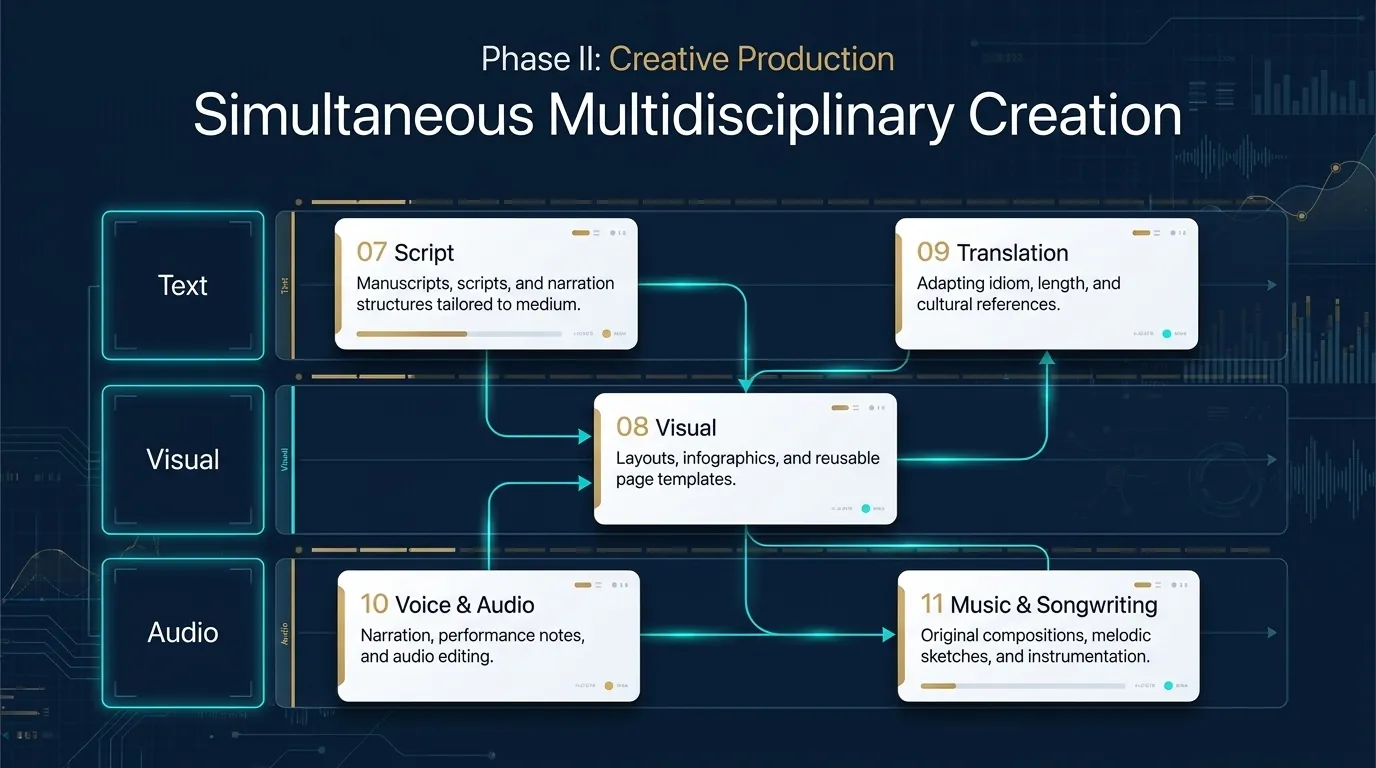
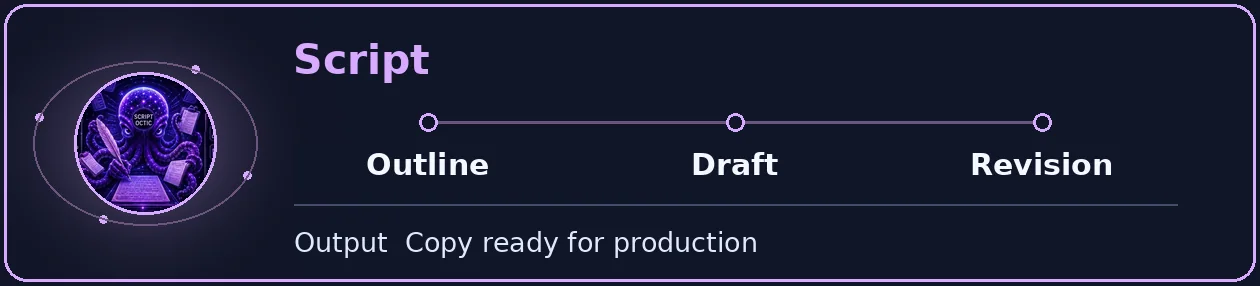
Script. Outline, Draft, Revision. Output: Copy ready for production.07Writing and editorial preparationStudio module · Script
Script. Outline, Draft, Revision. Output: Copy ready for production.

Script develops written material for reading, viewing, or listening. It shapes manuscripts, scripts, and narration around a structure suited to each medium. A book chapter may need a clearer sequence of ideas, while a video script may need shorter lines and cues for what appears on screen. Editorial work addresses clarity, consistency, and the author’s voice. The module delivers copy prepared for layout, recording, or production.

Visual. Style, Sketch, Artwork. Output: Design assets and layouts.08Design, illustration, and page layoutStudio module · Visual
Visual. Style, Sketch, Artwork. Output: Design assets and layouts.

Visual designs covers, illustrations, layouts, infographics, and presentation graphics. It establishes typography, color, spacing, and image treatment suited to the subject and reading conditions. It turns concepts or source data into illustrations and diagrams that help the audience understand the material. For a publication series, it can create reusable page templates that accommodate chapters of different lengths. The finished designs are prepared for their intended page sizes, screens, or placements.

Translation & Localization. Translate, Adapt, Review. Output: Localized edition.09Language adaptation and localized editionsStudio module · Translation & Localization
Translation & Localization. Translate, Adapt, Review. Output: Localized edition.

Translation & Localization adapts publications, documents, scripts, subtitles, and campaign content for audiences in other languages. It preserves the intended meaning and tone while adjusting idiom, spelling, and cultural references where needed. A project glossary keeps specialized terms consistent across editions. Format requirements guide decisions such as how much text a subtitle can carry or how to handle a heading that becomes longer in translation. The result is a language version suited to its intended readers or viewers.

Voice & Audio. Script, Recording, Mix. Output: Finished spoken audio.10Narration, voice-over, and audiobooksStudio module · Voice & Audio
Voice & Audio. Script, Recording, Mix. Output: Finished spoken audio.

Voice & Audio produces audiobooks, narration, and voice-overs. It develops performance notes for pronunciation, emphasis, pacing, and delivery. A short sample lets the client hear how the voice handles the material before recording proceeds. Audio editing addresses unwanted noise, distracting pauses, and uneven levels while preserving the natural rhythm of the spoken word. A finished audiobook can be delivered as chapter files in the formats agreed with the client.

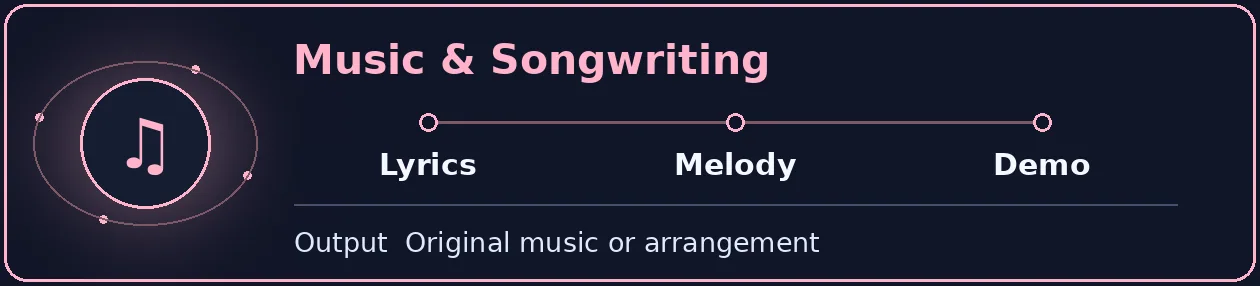
Music & Songwriting. Lyrics, Melody, Demo. Output: Original music or arrangement.11Original songs, compositions, and arrangementsStudio module · Music & Songwriting
Music & Songwriting. Lyrics, Melody, Demo. Output: Original music or arrangement.

Music & Songwriting creates original songs, instrumental compositions, themes, and arrangements. A project can begin with a lyric, a melodic sketch, or a description of what the music should convey. Songwriting develops melody and structure around the words, while arrangement determines the instrumentation and how it supports the performance. Music written to picture can follow the timing of specific scenes or transitions. Depending on the project, the client may receive a demo, a finished recording, or separate tracks for use in a mix.

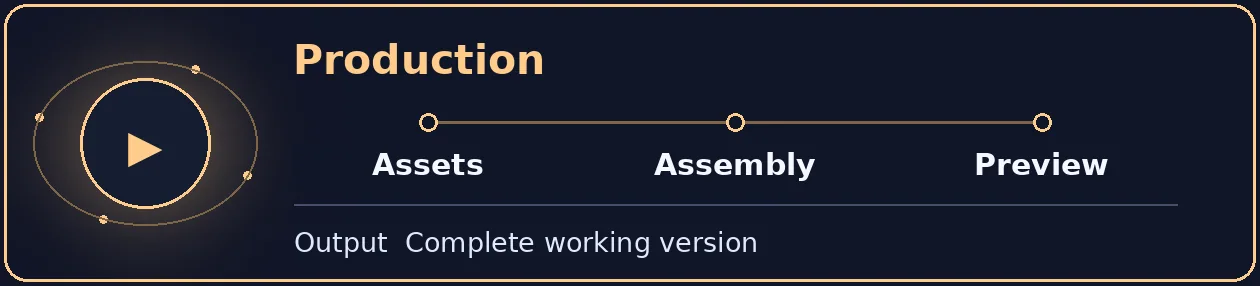
Production. Assets, Assembly, Preview. Output: Complete working version.12Assembly of approved materials into a working versionStudio module · Production
Production. Assets, Assembly, Preview. Output: Complete working version.

Production brings approved creative materials together into a complete working version. For a digital publication, it assembles chapters, artwork, navigation, and any interactive elements. For a video, it combines footage, narration, graphics, and music into a working sequence. Production tracks missing pieces and identifies where an asset must be resized, replaced, or adapted to fit. The assembled work gives the client and production team a complete version to review in context.

Edit. Edit, Revise, Export. Output: Final production files.13Revisions, post-production, and technical exportsStudio module · Edit
Edit. Edit, Revise, Export. Output: Final production files.

Edit refines the assembled work in response to review. In a video, it can shorten a sequence, reorder shots, or adjust the timing of graphics and captions. In a digital publication, it incorporates corrections and resolves issues that become visible once the text and artwork are assembled. It applies agreed revisions across the affected versions so that a correction appears wherever it belongs. It then exports the approved work to the agreed technical specifications.

Guardian. Check, Resolve, Verify. Output: Quality and permissions review.14Quality, usage permissions, and acceptance reviewStudio module · Guardian
Guardian. Check, Resolve, Verify. Output: Quality and permissions review.

Guardian checks the finished work against the project’s acceptance criteria. It verifies items such as navigation, readability, caption timing, and whether the files open as intended. It also reviews available usage permissions and required credits for third-party material. Unresolved issues are documented with their impact and the action needed before delivery. For example, Guardian may flag an image with permission for use in the publication that still needs clearance for paid promotion.

Release, Promotion and Budget5 modules

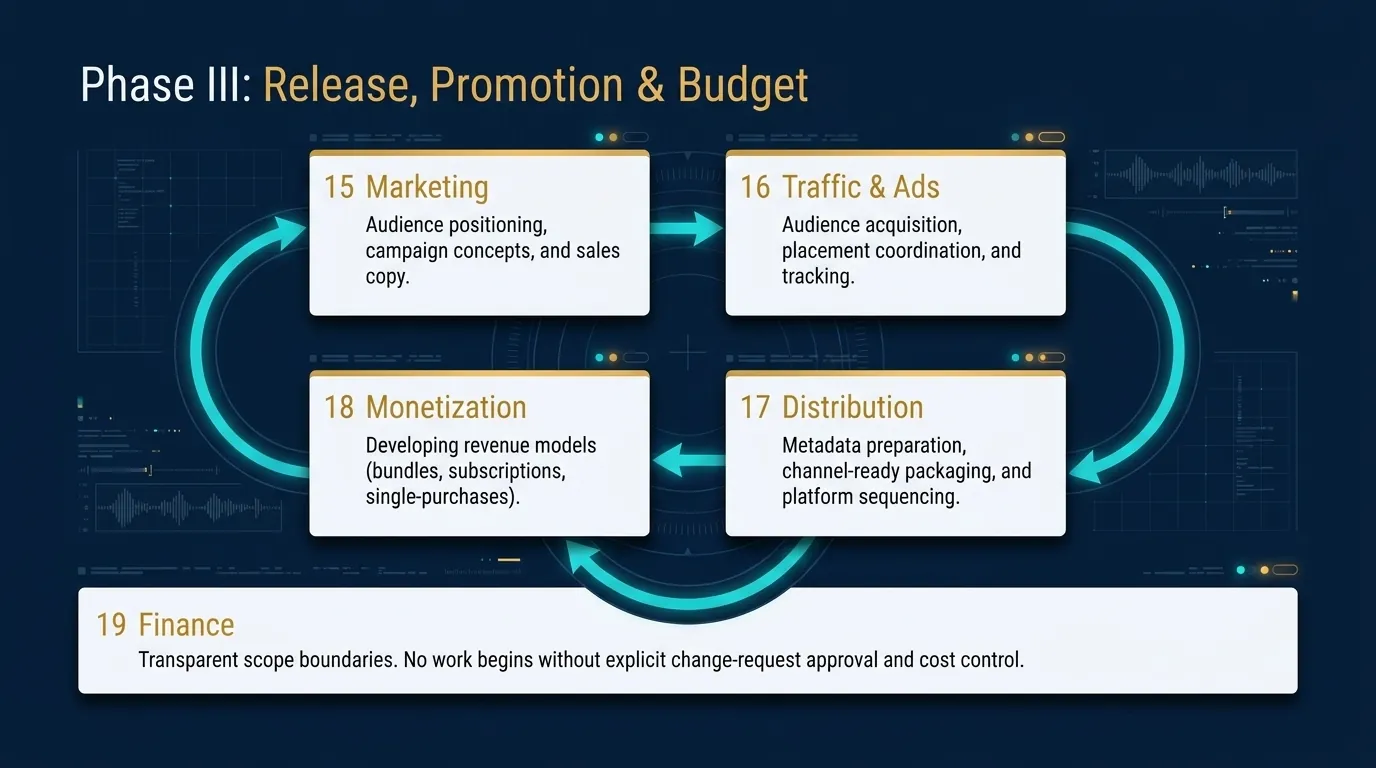
Marketing. Positioning, Message, Campaign. Output: Launch communications plan.15Positioning and campaign communicationsStudio module · Marketing
Marketing. Positioning, Message, Campaign. Output: Launch communications plan.

Marketing defines how the work will be presented to its intended audience. It turns the value of the publication, product, or service into a clear message supported by specific details. It plans what to communicate before launch, on release day, and in the weeks that follow. A publication campaign might focus on an advance excerpt, an author interview, and a sample chapter, each with a distinct purpose. The campaign plan gives each message an audience, a channel, and a reason to appear when it does.


Traffic & Ads. Placement, Test, Measure. Output: Advertising test results.16Audience acquisition and advertising testsStudio module · Traffic & Ads
Traffic & Ads. Placement, Test, Measure. Output: Advertising test results.

Traffic & Ads plans how to bring relevant visitors to a release page or offer. It selects placements and audience segments for paid campaigns and sets up tracking for the actions that matter. Tests can compare how different audiences respond to the same creative under a controlled spend. Results are assessed against outcomes such as qualified enquiries or completed purchases. This provides a basis for deciding which placements to expand, adjust, or stop.

Distribution. Prepare, Schedule, Release. Output: Platform-ready release package.17Release files, metadata, and platform schedulesStudio module · Distribution
Distribution. Prepare, Schedule, Release. Output: Platform-ready release package.

Distribution prepares a finished work for its selected release channels. It organizes listings, cover images, descriptions, and metadata according to each platform’s requirements. It matches the correct edition and format to each destination and coordinates release dates across channels. Where the client provides access and includes submission in the scope, the company can assist with uploading files and tracking their status. For a multilingual publication, this helps ensure that each edition appears under the correct title, language, and listing.

Monetization. Offer, Pricing, Revenue. Output: Commercial model.18Offers, pricing, and revenue modelsStudio module · Monetization
Monetization. Offer, Pricing, Revenue. Output: Commercial model.

Monetization develops the commercial offer around a publication, media product, or service. It considers how customers will pay, whether through individual purchases, bundles, subscriptions, or custom packages. It defines what each price includes and what can be purchased separately. A publisher might offer an ebook on its own and a combined edition that includes the audiobook and companion materials. The resulting offer gives customers a clear account of what they receive at each price.

Finance. Estimate, Set limits, Review costs. Output: Project budget.19Cost estimates and spending controlsStudio module · Finance
Finance. Estimate, Set limits, Review costs. Output: Project budget.

Finance estimates what the agreed work will cost to produce and deliver. The estimate can account for specialist fees, licenses, software, rendering, and other resources specific to the assignment. It sets spending limits and identifies commitments that require a decision before costs are incurred. If a change affects the estimate, Finance shows where the difference comes from and what can still be adjusted. For example, it can calculate the cost of ordering original illustrations for every chapter or limiting them to chapter openers and key explanations.

Analytics and Improvement3 modules

Insight. Collect, Compare, Report. Output: Post-launch analysis.20Post-launch performance analysisStudio module · Insight
Insight. Collect, Compare, Report. Output: Post-launch analysis.

Insight examines what happened after a release using the data available from the selected channels. It looks at measures such as downloads, viewing completion, enquiries, and sales in relation to the project’s objectives. It can show where audience behavior varied across editions, formats, or markets. For example, strong video completion alongside few visits to the release page may point to low visibility of the link or a weak call to action. The analysis records what the data shows and which explanations still need evidence.

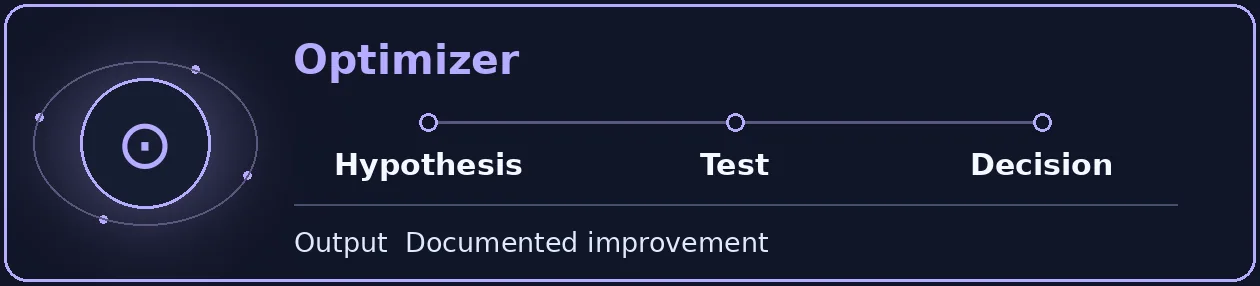
Optimizer. Hypothesis, Test, Decision. Output: Documented improvement.21Controlled tests for specific improvementsStudio module · Optimizer
Optimizer. Hypothesis, Test, Decision. Output: Documented improvement.

Optimizer designs and tests a specific improvement to a live asset or customer journey. It defines the proposed change, the measure of success, and the conditions needed for a fair comparison. A test might move a sample chapter higher on a publication page while keeping the offer and traffic source consistent. Where the available data supports a decision, the result determines whether the change is adopted, revised, or withdrawn. The module documents the tested version and the reasoning behind the decision.

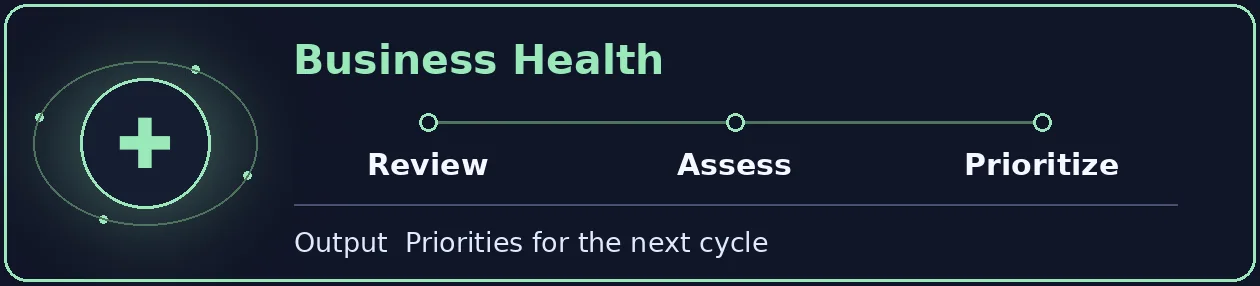
Business Health. Review, Assess, Prioritize. Output: Priorities for the next cycle.22Operating review and priorities for the next cycleStudio module · Business Health
Business Health. Review, Assess, Prioritize. Output: Priorities for the next cycle.

Business Health reviews whether a project or service line is sustainable across multiple assignments or release cycles. It looks for recurring patterns in turnaround, rework, workload, and the mix of work clients request. A growing audiobook service, for example, could have steady demand while delays in pronunciation review limit how many titles the team can deliver. The review identifies which constraints are worth addressing and where the business has room to expand. It closes with operating priorities for the next cycle, such as adding specialist capacity, changing the standard scope, or investing in a recurring publication series.

See how it all
comes together.

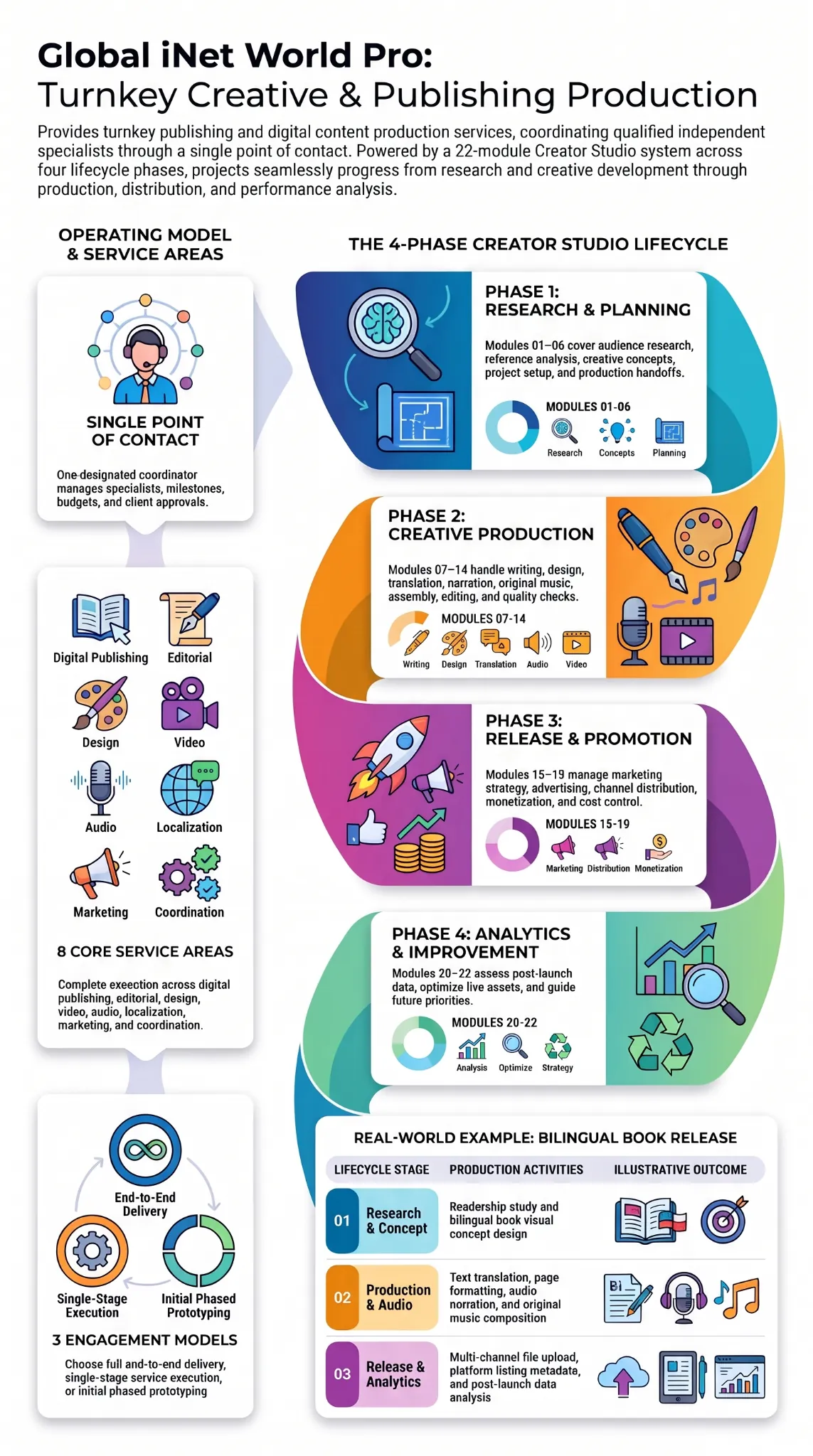
Explore our services, production lifecycle and connected modules in two complementary infographics. Open either diagram for a larger view.

The book example illustrates a possible workflow; it is not a completed client case study.

A bilingual book,
from manuscript to launch

A publisher supplies a manuscript for release in two languages. All work follows one production schedule, with key decisions approved through one company representative.

  1. Research

    We study the intended readership and propose a design concept for the book.

  2. Production

    We create the illustrations and page layouts, translate the text, and adapt the layout for the second edition.

  3. Audio and Music

    In parallel, we record the audio edition and compose an original musical theme for it.

  4. Release

    We prepare the files and listing materials for the selected platforms and support publication.

  5. Analytics

    After launch, we review the available results.

Know what is included.

Your proposal defines the scope, deliverables, milestones and review rounds. Changes are discussed before extra work begins.

Materials and volume

Word count, running time, number of illustrations and the condition of existing materials shape the work involved.

Formats and languages

Specify the editions, channels and language versions you need, together with any editable source files.

Creative requirements

Original artwork, custom music and specialist research are scoped separately according to the brief.

Reviews and approvals

Agree who approves the work, how feedback is consolidated and which revisions the price includes.

One company representative coordinates the independent specialists required for your project. Platform acceptance, campaign performance and commercial outcomes are not guaranteed.

A few useful
answers.

Every project starts with a conversation about what you want to create.

Ask about your project
Do I need a finished manuscript or brief?

No. You can start with an idea, an outline or existing source materials. Tell us what you have and what you want to achieve; the first step is to clarify the scope and intended audience.

Can I request just one service?

Yes. You can request a complete production or a specific stage, including design, editorial work, narration, original music, translation or release preparation. We use only the modules relevant to the agreed assignment.

How are the price and timeline determined?

They depend on the volume of material, formats, languages, creative requirements and review stages. A proposal records the deliverables, schedule, budget and included revisions before work begins.

Can you work in more than one language?

Translation and localization can be requested separately or alongside production. Target languages, specialist availability, terminology and review requirements are confirmed for each project.

What should I include in my enquiry?

Describe the outcome you want, the materials you already have, the intended audience, formats and languages, and any preferred deadline. Use the project enquiry form to share your brief and supporting files.

What happens to the finished files and usage rights?

The project agreement specifies the files you receive and the usage rights included. Requirements for editable source files, third-party assets, credits and licenses should be discussed when defining the scope.

Tell Us About
Your Idea

Share what you want to create, what materials you already have, the target languages if relevant, and your preferred deadline.

Open the Project Enquiry Form

Open original image